Congratulations on your new home. You’ve spent months reviewing floor plans, selecting finishes, choosing countertops and cabinets and flooring. And somewhere in the excitement, buried in a line item on a spec sheet you probably didn’t scrutinize, is the garage door: a builder-grade steel door that looks fine in the rendering and will quietly underperform for years if you let it.
Builder-grade garage doors are not bad products. They open. They close. They fulfill the basic contract. But they are consistently specified by builders for one reason: they are the least expensive option that meets code. They are not specified for energy performance, aesthetic impact, longevity, security, or the daily quality of life of the person who will use the garage as the primary entry point to their home dozens of times a week.
This guide explains exactly what you got with your builder-grade door, what you’re missing, and how a garage door installation and replacement transforms one of the most-used — and most overlooked — systems in your new home.
1. What “Builder-Grade” Actually Means for Your Garage Door
Builder-grade is a polite term for minimum viable product. In the context of garage doors, it typically means:
- Single-layer or thin double-layer steel construction: A single-layer door has an R-value of approximately R-2. Many builder-grade “insulated” doors use a thin polystyrene backer rather than a bonded polyurethane core, which delivers R-6 to R-8 at best and performs below that in real conditions due to air gaps at the panel edges.
- 24-gauge or thinner steel: Thinner gauge steel dents more easily and is more vulnerable to surface damage that allows rust to establish. Premium doors use 22-gauge or heavier steel.
- Steel rollers: Noisy, shorter-lived, and harder on the tracks than nylon. The grinding sound many homeowners notice on their new home’s garage door is usually steel rollers on the track.
- Basic chain drive opener: Functional, affordable, and loud. If your garage is directly below or adjacent to a bedroom, you’ve already noticed the sound. Chain drive openers also typically lack battery backup and smart connectivity in their base configurations.
- Raised panel design in white: The most generic style available, chosen because it offends no one and distinguishes nothing. It also doesn’t complement any specific architectural style particularly well.
None of this is hidden or deceptive — it’s just the reality of how new construction economics work. The builder’s margin depends on cost management across hundreds of line items, and the garage door is one where savings are easy because buyers rarely scrutinize it until they’re living with the result.
2. The Energy Cost You’re Paying Every Month
The garage door is the largest opening in your home. For an attached garage — which shares walls, ceilings, and sometimes floors with the living space — the door’s thermal performance directly affects your heating and cooling costs. This is where builder-grade doors consistently underdeliver, and where the financial case for upgrading is clearest.
An uninsulated or minimally insulated garage door allows:
- Summer heat gain: A south- or west-facing garage door absorbs significant solar radiation and re-radiates it as heat into the garage. On a hot afternoon, an uninsulated garage can be 20–30°F hotter than the outside temperature, driving that heat into the living space through the shared wall.
- Winter heat loss: An uninsulated door in winter is losing heat through the largest opening in your exterior envelope. Every degree of temperature difference between the garage and the outside increases the heating load on the room on the other side of the shared wall.
- Air infiltration: Gaps at the sides, top, and bottom of the door allow conditioned air to escape and unconditioned air to enter. Builder-grade weatherstripping degrades faster than premium alternatives and may already be imperfect on installation.
Homeowners upgrading from builder-grade to a quality insulated door on an attached garage typically report annual energy savings of $100–$300 per year. Over the 15–20-year lifespan of a premium door, that’s $1,500–$6,000 in cumulative savings — a meaningful return on a one-time upgrade investment.
3. The Noise Problem Nobody Warned You About
If you use the garage as the primary entry to your home — as most attached-garage households do — you’re cycling the door 4, 6, sometimes 8 or more times per day. A chain drive opener with steel rollers on a thin-panel door is audible throughout a significant portion of the home on every one of those cycles.
This matters most in three situations that are extremely common in new construction homes:
- Bedroom above or adjacent to the garage: Early morning departures and late returns wake light sleepers. With a newborn or young children, this becomes a daily source of stress.
- Home office adjacent to the garage: A grinding chain drive is audible on video calls and disruptive to focused work.
- Open-plan living near the garage entry: In modern open-plan layouts, the garage entry connects directly to the main living area, and sound travels freely.
A belt drive or direct drive opener with nylon rollers on an insulated door operates at a fraction of the noise level of a builder-grade setup. The difference is not subtle — it’s the difference between a system that announces itself throughout the house and one that you barely notice.
4. The Curb Appeal Gap You’ve Probably Already Noticed
Drive down any street of new homes built in the last decade and look at the garages. The majority have the same basic white raised-panel door in one of two or three standard sizes. It’s not offensive, but it’s also not doing anything for the home’s character. In a neighborhood where every house looks similar from the street, the garage door is one of the few elements that can actually differentiate your home visually.
The garage door accounts for up to 40% of the home’s front-facing facade on most properties. A door that’s been chosen to complement the specific architectural style — rather than to fulfill a generic spec — changes the entire visual impression of the home from the street.
What a style-matched door does for a new construction home:
- Craftsman or farmhouse exterior: A carriage-house style door with horizontal plank detailing, decorative hardware, and a warm wood-look finish transforms the garage from generic to characterful. The visual coherence extends to the entire facade.
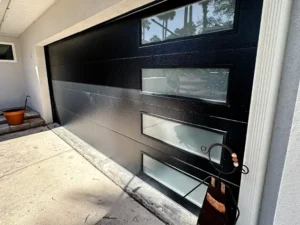
- Contemporary or modern exterior: A full-view aluminum and glass door in a dark frame makes a dramatic statement that photographs beautifully and immediately reads as a deliberate design choice.
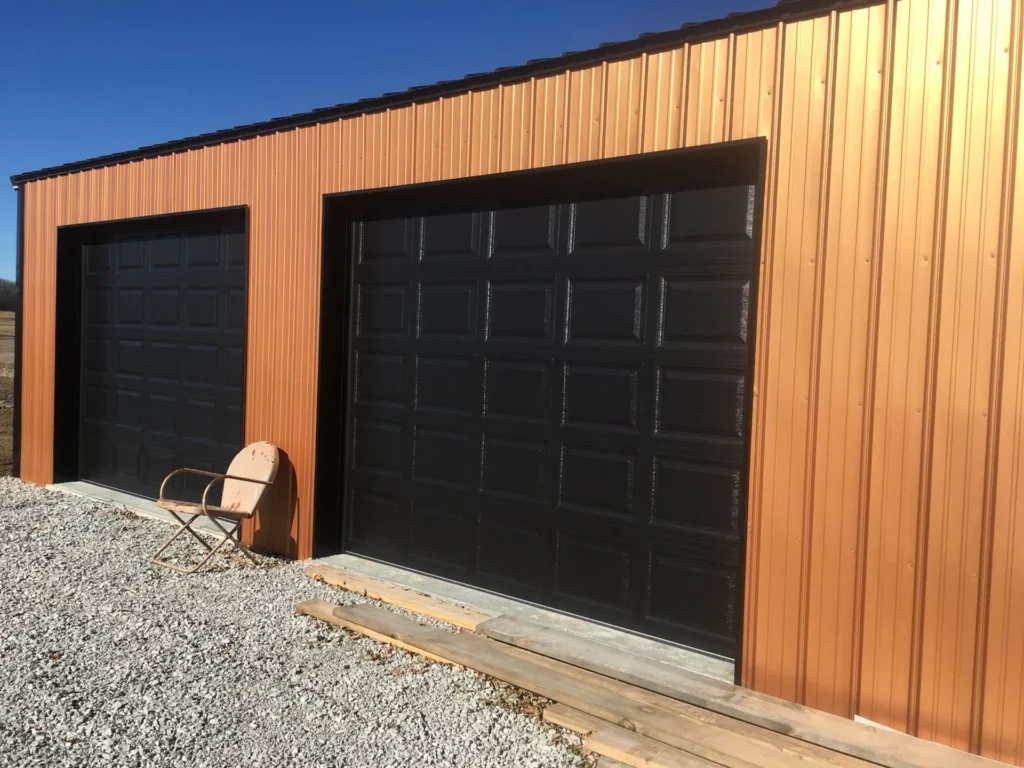
- Traditional exterior: An upgraded raised-panel door in a bold color — charcoal, deep navy, or forest green — against the home’s lighter exterior creates the kind of contrast that makes the home memorable from the street.
5. The Security Gaps in a Builder-Grade System
Builder-grade openers are often installed with the minimum security features that meet manufacturer standards at the time of construction. Depending on when your home was built and what your builder specified, your opener may be missing protections that are now considered standard:
- Rolling code technology: Modern openers generate a new encrypted code with every remote press, making signal interception impossible. Older fixed-code openers can be cloned. If your home’s opener was installed with a budget-tier unit, confirm it uses rolling code technology.
- Battery backup: Base-level openers often omit battery backup to hit a price point. During a power outage — from a storm or any other cause — a door without battery backup is completely inoperable, leaving you locked in or out with no alternative.
- Smart monitoring: Entry-level openers have no remote monitoring capability. You can’t check whether the door is closed from your phone, receive an alert if it’s been open for an hour, or close a forgotten door from work.
- Emergency release security: The emergency release cord on any opener can be exploited from outside through the top gap of the door. A simple zip tie through the release lever prevents this exploit while still allowing manual release in a genuine emergency.
6. What a Full Replacement Gets You That Upgrades Don’t
It’s worth understanding the distinction between upgrading individual components — swapping the opener, adding insulation panels, replacing rollers — and doing a full installation and replacement. Each approach has its place, but a full replacement delivers things that piecemeal upgrades can’t:
- Purpose-built insulation: A retrofitted insulation kit adds some thermal performance to an existing door. A new triple-layer door with a polyurethane foam core chemically bonded to both steel skins delivers R-12 to R-18 with no air gaps — fundamentally better construction than any retrofit can replicate.
- New springs and cables: A replacement comes with fresh springs and cables correctly tensioned for the new door’s weight. Keeping an aging or undersized spring system under a component-upgraded door is a deferred maintenance problem.
- Full manufacturer warranty: A new door and opener carry full warranty coverage on all components — parts and labor — from day one. Retrofit components carry their own warranties that don’t cover the existing door system around them.
- Correct sizing for your actual use: If the builder-grade door is 8 feet wide and you now drive a full-size truck with a wide mirror profile, a replacement is the opportunity to get the dimensions right for how you actually live.
- Fresh aesthetics: The style, color, and window configuration are chosen by you, for your home, rather than inherited from a builder’s spec list.
7. How to Specify the Upgrade: What to Ask For
When you’re ready to move from builder-grade to best-in-class, here’s what to specify to ensure you’re getting a genuine upgrade rather than a lateral move:
For the door:
- 22-gauge steel or heavier (not 24-gauge builder-grade)
- Triple-layer construction with polyurethane foam core (not polystyrene backer)
- R-12 minimum for attached garages; R-16 for cold climates or garages used as workspaces
- UV-resistant factory finish (not bare steel or basic primer)
- Style matched to the home’s architecture — not just the least expensive available option
For the opener:
- Belt drive or direct drive (not chain drive for an attached garage)
- 25 hp or higher for a heavy insulated door
- Battery backup included (not optional)
- Rolling code security standard
- Wi-Fi smart connectivity with app control and real-time alerts
For the hardware:
- Nylon rollers (not steel)
- High-cycle springs rated for 25,000+ cycles (not standard 10,000-cycle builder-grade springs)
- Quality weatherstripping on all four sides — bottom seal, side seals, and top seal
8. When to Make the Move
The best time to upgrade a builder-grade garage door is before it becomes a problem rather than after. Here’s how to think about timing:
- Immediately after move-in: If curb appeal, noise, or energy performance are already bothering you, there’s no reason to wait. The upgrade delivers daily benefits from the first day.
- Within the first 2–3 years: Builder-grade springs are rated for 10,000 cycles. A household using the door 6 times a day will burn through that in about 4–5 years. Getting ahead of the first spring replacement with a full upgrade makes financial sense.
- Before any exterior renovation: If you’re planning landscaping, exterior paint, or other curb appeal improvements, doing the garage door at the same time ensures the whole exterior is addressed cohesively.
- Before listing the home: If a sale is on the horizon, a new door photographed well and highlighted in listing copy is one of the most effective exterior improvements available at the price point.
Final Thoughts
Your new home came with a lot of things that are exactly right for your family and a few things that were specified for someone else’s budget. The garage door is almost certainly in the second category. It opens and closes — but it’s costing you in energy, noise, security, and curb appeal every single day.
The good news is that a garage door installation and replacement is one of the fastest, highest-impact upgrades available to a new homeowner. One day of professional installation transforms the entry point you use most, the most visible feature of your home’s exterior, and the thermal and acoustic performance of the space connected to your living area. It’s not a project you need to live with the builder’s choice for.
Ready to upgrade from builder-grade to best-in-class? Contact Us at Flash Garage Door Service helps new homeowners get the garage door system their home actually deserves — with expert installation, honest guidance, and a wide selection of doors and openers to match any style and budget. Contact us today for a free estimate.
About the Author: This post was developed with residential garage door installation specialists to help new homeowners understand what builder-grade garage doors deliver — and what a professional installation and replacement upgrade provides in return.