A new garage door installation is one of the most impactful home improvement decisions a Kansas City homeowner can make. It affects curb appeal, energy efficiency, security, and daily convenience all at once — and it’s a decision that will shape how your home looks and functions for the next 15 to 30 years. Getting it right means more than just picking a door that looks good in a catalog.
Kansas City’s climate — hot, humid summers, cold winters with significant ice and snow, and a wide temperature swing across the year — creates specific demands on a garage door that generic buying advice doesn’t fully address. This guide covers everything Kansas City homeowners need to know to make a confident, well-informed installation decision: from sizing and material selection to insulation, style, and what professional installation actually involves.
1. When Is It Time to Replace Your Garage Door?
Not every garage door problem calls for full replacement — but some situations clearly do. Here’s how to assess where you stand:
- Age: A quality steel garage door can last 20–30 years. If your door is 15+ years old, showing widespread rust or structural wear, and requiring repeated repairs, full replacement is almost always more economical than continued patching.
- Repair costs: If the cost of needed repairs exceeds 50% of a comparable new door’s installed price, replacement delivers more value — you get new components, a full warranty, and modern safety and energy features rather than investing in a declining system.
- Structural damage: Widespread rust penetrating through the panel surface, significant warping, or a frame that no longer closes squarely against the opening are signs of structural deterioration that repair doesn’t adequately address.
- Missing modern features: A door that lacks insulation on an attached garage, an opener without rolling code security or battery backup, or a system with no smart connectivity may be functionally adequate but is costing you in energy bills, security exposure, and daily convenience.
- Curb appeal: The garage door accounts for up to 40% of a home’s front-facing facade. A door that’s faded, dented, or stylistically outdated undermines the entire exterior’s appearance — and a new door that complements the home’s architecture is one of the fastest ways to improve it.
2. Getting the Size Right: Measurements That Determine Everything
Sizing is the foundation of a garage door installation. A door that doesn’t fit the opening correctly is a security risk, an energy drain, and an expensive correction. Before selecting any style or material, you need four accurate measurements:
- Width: Measure the opening from left to right at its widest point. Standard single doors are 8–9 ft; double doors are 16 ft. Consider sizing up if you drive a full-size truck, SUV, or plan to add a car lift — a 9 or 10-foot single door gives significantly more clearance than an 8-foot one.
- Height: Standard heights are 7 or 8 ft. If you drive a lifted truck, a cargo van, or are planning a two-post lift, 8-foot minimum height is important. Standard 7-foot doors eliminate most lift configurations.
- Headroom: The space between the top of the opening and the ceiling. Standard torsion spring openers need at least 10–12 inches. If headroom is limited, low-clearance hardware is available. If a car lift is planned, high-lift or vertical-lift track conversions maximize usable ceiling height.
- Side room: The space on each side of the opening where the vertical tracks will be mounted. Standard installations need at least 3–4 inches on each side.
Professional installers measure your opening before any order is placed — a critical step that prevents the costly mistake of ordering a door that doesn’t fit. If you’re unsure about any of these measurements, a pre-installation site visit resolves all of them.
3. Choosing the Right Material for Kansas City’s Climate
Material selection has more impact on long-term performance in Kansas City than in more moderate climates. The region’s wide temperature range — from below zero in January to 100°F in August — stress-tests materials that perform adequately in temperate climates. Here’s how the main options hold up:
Steel (insulated) — Best overall choice for Kansas City
Steel doors with a polyurethane foam core are the most practical choice for most Kansas City homes. They handle temperature extremes well, resist warping, and are available in a wide range of styles. Heavier gauge steel (22 gauge) resists denting better than the 24 gauge steel used in budget doors. Look for a factory-applied prime and paint finish — bare steel exposed at any chip or scratch will rust faster in Kansas City’s freeze-thaw cycles.
Wood — Beautiful but demanding
Wood doors offer unmatched natural character and can be custom-built for any size or style. The challenge in Kansas City’s climate is the seasonal moisture cycling — wood expands in humid summers and contracts in dry winters, stressing paint and sealant and eventually causing cracking and warping if not maintained. A wood door here requires annual inspection and resealing or repainting. For homeowners committed to that maintenance, wood delivers an aesthetic nothing else matches.
Wood composite — Better durability, similar look
Composite doors use wood fiber and resin construction that resists warping and moisture absorption significantly better than solid wood. They replicate wood grain convincingly and are a strong middle-ground for homeowners who want the wood aesthetic with better dimensional stability in Kansas City’s climate.
Aluminum — Lightweight and modern
Aluminum doors are lighter than steel, naturally rust-resistant, and well-suited to contemporary and modern architectural styles. The tradeoff is dent resistance — aluminum dents more easily than steel, which matters more in a climate with occasional hail. Full-view aluminum and glass doors are a premium aesthetic option for contemporary homes.
4. Insulation: A Kansas City Priority
Insulation is where Kansas City homeowners should pay particular attention. The region’s cold winters and hot summers create significant temperature differentials that a well-insulated door meaningfully reduces. For an attached garage — which shares walls directly with the living space — the garage door’s insulation level directly affects heating and cooling costs and comfort.
R-value recommendations for Kansas City:
- Detached garage: Insulation is less critical with no shared thermal envelope. A single-layer uninsulated door is adequate if cost is the primary constraint.
- Attached garage: R-12 to R-16 minimum. Kansas City’s cold winters make this particularly important — an uninsulated door in January is losing significant heat through the largest opening in your exterior envelope.
- Garage workshop or living space: R-16 to R-18. Maximum insulation makes the space genuinely usable in January and August rather than only in mild weather.
Insulation construction matters: A triple-layer door with polyurethane foam core chemically bonded to both steel skins outperforms a double-layer door with a polystyrene backer at the same nominal R-value, because the bonded construction eliminates the air gaps at panel edges that reduce real-world thermal performance.
5. Style and Design: Matching the Door to the Home
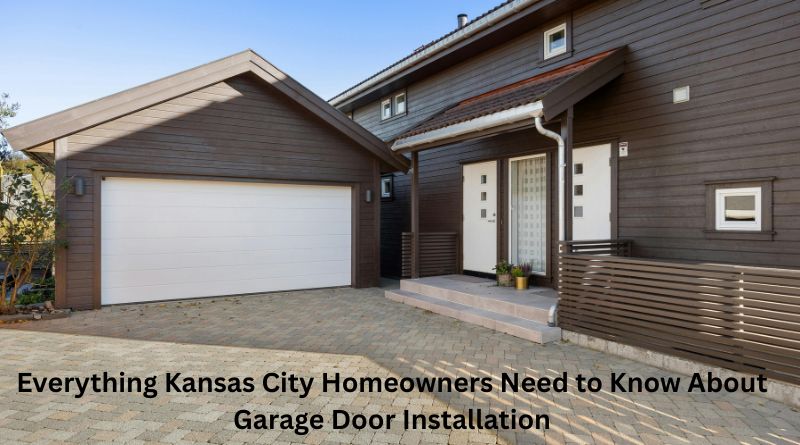
The garage door is the largest single element on most home facades. A door that complements the home’s architecture creates cohesion that elevates the entire exterior. One that clashes creates friction that no amount of landscaping or paint overcomes. Here’s how Kansas City’s most common architectural styles translate to door selection:
- Traditional and Colonial: Raised-panel steel doors in white, cream, or classic neutrals. Rectangular panel arrangements with symmetrical proportions. Common throughout Kansas City’s established neighborhoods.
- Craftsman and Bungalow: Carriage-house style doors with horizontal plank detailing, decorative strap hinges, and coach handles. Wood or wood-look steel in warm earth tones, browns, or sage greens. Well-suited to Kansas City’s Midcentury and Craftsman neighborhoods.
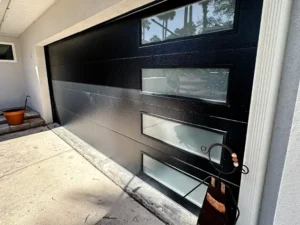
- Contemporary and Modern: Flush steel or aluminum frames with clean horizontal lines. Full-view aluminum and glass panels for a dramatic modern statement. Popular in newer Kansas City area developments.
- Farmhouse: Barn-inspired designs with vertical plank detailing in painted white or deep classic colors with contrasting black hardware. Strong curb appeal and increasingly popular across the metro area.
Color strategy: Bold door colors — charcoal, black, deep navy, forest green — against lighter home exteriors are one of the most reliably impactful curb appeal moves available. Use a door design visualization tool to see how different combinations look on your specific home before committing.
6. Choosing the Right Opener for Your New Door
A new door installation is the natural time to evaluate the opener as well. The door and opener work as a system — a mismatched opener causes problems from day one and shortens the lifespan of both components.
- Belt drive: Quietest standard option. The right choice for garages adjacent to or below bedrooms and living spaces — common in Kansas City’s attached-garage homes. Reliable and low-vibration.
- Chain drive: Most affordable and mechanically durable. Suitable for detached garages where noise isn’t a concern. Proven reliability through Kansas City’s temperature extremes.
- Direct drive: One moving part. Exceptionally quiet and reliable with minimal maintenance needs. The premium longevity choice.
- Jackshaft: Wall-mounted beside the door. Frees ceiling space for storage or lifts. Ideal for garages with high ceilings or specialty configurations.
Features every Kansas City homeowner should prioritize:
- Battery backup: Kansas City’s severe storm season regularly knocks out power. Battery backup ensures full door operation during and after outages.
- Rolling code security: Generates a new encrypted code with every remote press. Standard on modern openers and a genuine security improvement over older fixed-code systems.
- Smart connectivity: Smartphone control, real-time alerts, activity logs, and auto-close scheduling. Eliminates the “did I close the garage?” concern entirely.
- Correct horsepower: Match motor power to door weight. Heavy insulated doors need at least 1.25 hp. Undersizing strains the motor and reduces its lifespan.
7. What Professional Installation Actually Involves
Garage door installation looks deceptively simple online. It isn’t. The most dangerous step — torsion spring tensioning — requires specialized winding bars and precise knowledge of the correct turns of tension for the specific door weight. A miscalculation or slip during this step can release spring tension catastrophically, causing severe injury. Beyond the safety issue, a poorly installed door wears faster, operates louder, and voids manufacturer warranties.
What a professional installation includes:
- Pre-installation measurement: Precise measurement of width, height, headroom, and side room to confirm the ordered door will fit correctly.
- Old door removal and disposal: Removal of the existing door, hardware, and tracks. Disposal of all old materials — confirm this is included in your quote.
- Panel and track installation: Panels installed in sequence, tracks mounted at correct angles and plumb, all hardware torqued to specification.
- Spring tensioning: Torsion springs tensioned to the precise specification for the door’s weight. This is the step that requires specialized tools and expertise — and the step that makes professional installation non-negotiable.
- Cable installation: Cables seated correctly on the drums and tensioned to maintain correct door balance.
- Opener mounting and programming: Opener installed, wired, and programmed with force and limit settings calibrated for the specific door.
- Safety inspection and handover: Balance test, auto-reverse test, photo-eye sensor alignment, and a complete system walkthrough with the homeowner.
8. The ROI Case: Why Installation Timing Matters
A new garage door consistently ranks among the top exterior home improvement projects for return on investment, frequently returning over 90% of its cost in added home value according to Remodeling Magazine’s annual Cost vs. Value Report. In Kansas City’s active real estate market, where curb appeal plays a meaningful role in buyer decisions, this return is well-supported by local market dynamics.
Best timing for installation:
- 6–12 months before listing: You enjoy the new door’s benefits while living in the home, and it looks fresh — not weathered — when buyers arrive.
- Right before listing: A new door photographs beautifully and gives agents a concrete upgrade to highlight in listing copy.
- Proactively before failure: Replacing a door showing early signs of systemic decline — repeated repairs, spreading rust, aging opener — before it fails completely is always cheaper and less disruptive than emergency replacement.
- New construction: Specifying the right door from the start — correct height, insulation, and style — avoids the more expensive corrections that come from accepting builder-grade defaults.
Your Kansas City Garage Door Installation Checklist
Before finalizing your installation:
- Accurate opening measurements confirmed — width, height, headroom, side room
- Material selected based on Kansas City’s climate and your maintenance preference
- R-value appropriate for attached garage and Kansas City’s winter temperatures (R-12 minimum)
- Style matched to the home’s architecture — use a design visualization tool before committing
- Opener selected with correct drive type, horsepower, battery backup, and smart features
- Written quote with itemized parts, labor, and warranty terms
- Old door removal and disposal confirmed as included
- Professional installation confirmed with safety inspection at handover
Final Thoughts
A garage door installation done right is a 20–30 year decision. The material, insulation level, style, opener, and installation quality all compound over that time — delivering either decades of reliable, efficient, attractive performance, or decades of recurring problems that trace back to shortcuts taken at the beginning.
For Kansas City homeowners, the additional consideration is the local climate. A door and insulation spec that’s right for this market — built for wide temperature swings, capable of handling freeze-thaw cycles, and matched to the architectural character of the neighborhood — performs fundamentally differently from a generic selection. Start with the right foundation and the rest follows.
Ready to plan your garage door installation? Sharp Overhead Door Service serves homeowners throughout the Kansas City metro area with expert installation, honest guidance, and the local knowledge to help you make the right choice for your home and climate. Contact us today for a free estimate.
About the Author: This post was developed with Kansas City garage door installation specialists to help homeowners throughout the metro area make informed, confident decisions about their garage door installation.