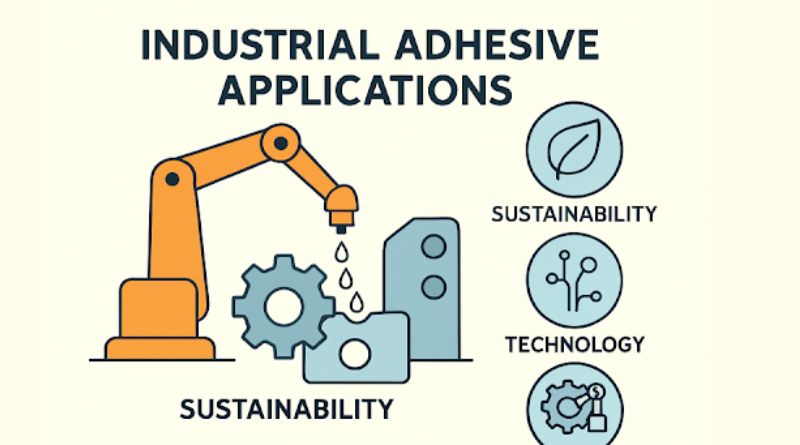
In the fast-evolving world of manufacturing and construction, industrial adhesives have become a critical component in creating durable and efficient products. From automotive assembly to electronics and packaging, adhesives provide versatile bonding solutions that often replace traditional mechanical fasteners. Recent developments in adhesive technology focus on enhancing strength, heat resistance, and environmental sustainability, reflecting the growing demand for materials that can meet complex industrial challenges. Researchers and manufacturers alike are exploring innovative formulations, including bio-based adhesives and advanced polymers, to achieve stronger, lighter, and more reliable bonds across a range of substrates.
For professionals and enthusiasts seeking a deeper understanding of these advancements, detailed resources are available; click here to explore emerging trends, new applications, and performance improvements in industrial adhesives. Staying informed about these developments helps industries adopt safer, more efficient, and cost-effective bonding solutions. As the field continues to grow, monitoring innovations ensures that businesses and engineers remain at the forefront of adhesive technology.
Bio-Based Adhesives: A Sustainable Shift
Bio-based adhesives are gaining widespread adoption as both companies and regulators focus on reducing the environmental impact of industrial activities. These adhesives are formulated with renewable raw materials, such as starches, natural resins, and plant-based polymers, rather than petroleum-derived components. One notable example is Henkel’s LOCTITE® HHD 3544F, a bio-based polyurethane reactive (PUR) hot melt adhesive designed for consumer electronics assembly, with approximately two-thirds of its content sourced from renewable, plant-based feedstocks. This move aligns with global sustainability targets and helps manufacturers reduce their dependence on fossil fuels while delivering strong bonding capabilities across sectors from automotive assembly to footwear production. The shift to bio-based options is partly driven by increasing consumer and regulatory demands for greener products.
Smart Adhesives: Integrating Technology
The rise of smart adhesives represents a major leap in the capabilities offered by industrial bonding solutions. These new adhesives can incorporate sensors to monitor joint integrity or respond to environmental changes by self-healing small cracks or damage. Industries such as aerospace, automotive, and healthcare are using smart adhesives to improve reliability, enable predictive maintenance, and extend product life. For instance, self-healing adhesives contain microcapsules that release repair agents when damaged, thus closing micro-cracks and preventing further failure. Sensing adhesives can detect stresses at the bond line, helping prevent catastrophic failures in critical applications. These innovations not only enhance safety but also reduce downtime and maintenance costs, making manufacturing much more efficient.
Automation in Adhesive Application
The integration of automation within adhesive application processes is revolutionizing industrial manufacturing. Automated dispensing and application systems are delivering unrivaled precision, consistency, and speed. One standout example is the ShurSEAL® Packaging Solution, which optimizes tape use and minimizes waste by employing sensors and robotics to ensure a perfect wipe-down and application every time. Automation reduces human error, ensures reproducibility, and enables real-time monitoring and adjustment of process parameters, making manufacturing leaner and more competitive. Many industries, especially packaging and electronics, are shifting from manual adhesive application to data-driven, automated solutions that also support ongoing digital transformation efforts.
Emerging Applications in Electric Vehicles and Electronics
New sectors like electric vehicles (EVs) and flexible electronics are expanding the market for industrial adhesives in innovative ways. In EV manufacturing, adhesives are vital for lightweighting, reducing vibration, and improving the thermal management and safety of battery packs. These demands require adhesives with specific thermal and electrical properties, as well as long-term durability even under harsh conditions. In flexible electronics, adhesives must be both reliable and elastic to withstand repeated bending and flexing. As these industries grow, especially amid the global transition to electric mobility and the rapidly evolving consumer electronics market, the demand for specialized adhesive formulations is set to rise. This opens up new revenue opportunities for adhesive manufacturers who can address the unique performance criteria in these high-growth sectors.
Market Growth and Future Outlook
The global industrial adhesive market is experiencing remarkable expansion, valued at around US$53.7 billion in 2024, with forecasts suggesting it will reach US$93.6 billion by 2032. With a compound annual growth rate (CAGR) of 7.2%, ongoing investments in research and development, tightening regulatory standards, and the continued adoption of digital and sustainable manufacturing techniques are thrusting the sector forward. As businesses face increased scrutiny over environmental impacts and operational efficiency, innovative adhesive solutions play a pivotal role in helping industries maintain competitiveness and meet evolving market requirements.
Summary
The future of industrial adhesives centers on innovation, sustainability, and technology-driven evolution. Companies that invest in next-generation adhesives and application technologies will be best positioned to capitalize on new opportunities, overcome challenges, and help shape the future of industrial manufacturing for years to come.