The garage door used to be the one part of the house that didn’t talk back. You pressed a button, it went up or down, and you hoped you remembered to close it.
Today, the garage door can be one of the most useful smart devices in your home. It can tell you when it opens, let you close it from across the country, let a dog walker in without a key, and give delivery drivers a safer place to leave packages than the front porch.
But not every feature is worth paying for, and not every setup is secure out of the box. Here’s what smart garage technology can do, how to add it, and what to watch out for.
What Smart Garage Tech Can Do
| Feature | What it does | Who it helps most |
| Open/close alerts | Sends a phone notification every time the door moves | Anyone who’s ever wondered, “Did I close the garage?” |
| Remote control | Lets you open or close the door from anywhere with an internet connection | Travelers, busy families, people letting in contractors |
| Scheduled or automatic closing | Closes the door at a set time, or after it’s been open for a set period | Households with kids and forgetful adults |
| Guest access | Creates temporary or limited access for sitters, family or service providers | Pet owners, homeowners using cleaners or dog walkers |
| In-garage delivery | Lets approved delivery drivers open the door briefly to drop off packages | Anyone dealing with porch theft or bad weather |
| Cameras | Built-in or paired cameras let you see the garage and record activity | Security-minded owners, people storing valuables |
| Voice and smart-home integration | Works with some smart speakers, car systems and home routines | Smart-home households |
| Activity history | Logs when the door opened, closed and who used it | Families, landlords, anyone tracking access |
Most of these work through a smartphone app tied to the opener or a hub. Exact features, and which platforms they work with, vary by brand and model.
Two Ways to Go Smart
Option 1: Add a smart controller to your existing opener. Many openers made in roughly the last 20 years can be upgraded with a plug-in hub or a small controller wired to the wall-button terminals. It’s the least expensive route and can give you alerts, remote control and scheduling.
This works best when your current opener is in good shape, has photo-eye safety sensors, and uses rolling-code security. Compatibility depends on the opener brand and model, so check before you buy.
Option 2: Replace the opener with a smart model. Many new openers come with Wi-Fi and app control built in, and often add features a retrofit can’t: quieter belt or wall-mount drives, battery backup, integrated cameras, better lighting and stronger security.
This makes more sense when your opener is 10 to 15 years old, noisy or unreliable, lacks modern safety features, or isn’t compatible with add-on controllers.
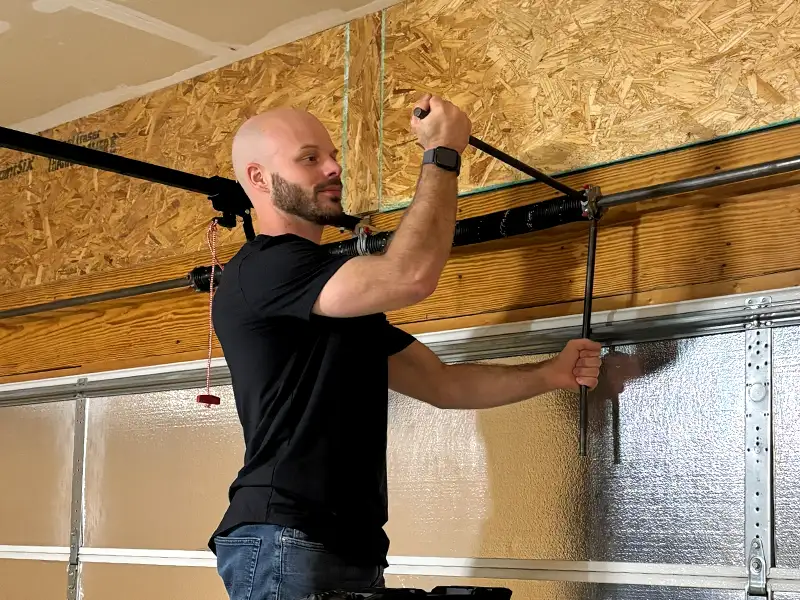
Either way, the smart features are only as good as the door they control. A smart opener can’t make up for weak springs, a door that’s out of balance or worn rollers.
Security and Privacy: Set It Up Right
A connected garage door is a door to your home on the internet, so treat its account like you’d treat a house key:
- Use a strong, unique password for the app account, and turn on two-factor authentication if it’s offered.
- Keep the app and firmware updated. Updates often fix security issues.
- Secure your home Wi-Fi with a strong password and current encryption.
- Review who has access regularly, and remove old guest codes, past contractors and former household members.
- Use temporary access for sitters and service providers rather than sharing your own login.
- Know what cameras record, where footage is stored, and who can see it, especially if a camera points toward neighbors or the street.
- Keep a physical backup. Know how to use the manual release and wall button if your internet or the app is down.
Smart features also improve old-fashioned security. Alerts and auto-close help prevent the most common garage break-in of all: a door someone simply forgot to close.
Getting the Setup Right
Check the Wi-Fi signal in the garage. Garages are often at the edge of a home’s Wi-Fi range, with metal doors and concrete walls in the way. A weak signal means missed alerts and commands that don’t go through. A mesh node or range extender near the garage often fixes it.
Confirm the safety features work. Remote and automatic closing depend on the door’s photo-eye sensors and auto-reverse working perfectly, because no one may be there to watch the door close. Many smart openers flash lights and sound a warning before closing remotely. Test the sensors and auto-reverse monthly.
Check compatibility before you buy. If you’re adding a controller to an existing opener, confirm it works with your opener’s brand, model and age. If you use a particular smart speaker, car or home platform, check that the opener supports it.
Set sensible automations. Auto-close after 10 or 15 minutes, or at a set time each night, is a good starting point. Avoid rules that could close the door while kids, pets or cars might be in the way.
Add battery backup. A smart opener that loses power isn’t very smart. Battery backup keeps it running through outages.
So, Is It Worth It?
For most households, the answer is yes, at least for the basics. Open/close alerts, remote control and auto-close solve real, everyday problems for a modest cost. Cameras, in-garage delivery and smart-home integrations are worth it if they fit how you live.
It’s less worthwhile if your opener is old and unreliable, since adding smart features to a failing unit is money poorly spent. In that case, replacing the opener with a smart model is usually the better investment.
When to call a pro: Have a technician install or replace an opener, especially on a heavier or insulated door, and check the door’s balance, springs and safety sensors before you start closing it remotely. A garage door that runs smoothly and reverses reliably is the foundation every smart feature depends on.
The best smart garage is one you never have to think about. It tells you what you need to know and quietly keeps your home a little safer.
About the Author
This article was written by the team at Swift Lift STL Garage Door Repair, a family-owned, IDEA Certified garage door company serving homeowners across St. Charles County and the greater St. Louis area. The team repairs and installs garage doors, springs, cables and openers, with same-day service on most calls and written warranties on parts and labor Contact Us.