There is a distinct, breathtaking violence to a military airdrop. Watching a massive tactical vehicle being dragged out of the open cargo ramp of a C-130 Hercules mid-flight is an incredible display of modern logistics. Parachutes deploy, catching the rushing atmosphere, and suddenly a piece of heavy machinery weighing thousands of pounds is suspended in the sky, drifting toward a combat zone.
To a casual observer, the parachutes are the star of the show. However, for the mechanical engineers and logistics experts behind the scenes, the true marvel is not the nylon canopy. The real engineering miracle is how the vehicle survives the drop without the parachutes simply ripping the chassis to shreds.
The Physics of Extreme Deceleration
When a 10,000-pound tactical vehicle is pushed out of an aircraft, gravity takes immediate control. Within seconds, the truck is in freefall. When the massive cargo parachutes finally deploy and bite into the air, the deceleration is violent and instantaneous.
During this moment of opening shock, the kinetic forces multiply the effective weight of the vehicle exponentially. If a rigging crew were to attach parachute cables to a standard commercial tow hook, a bumper, or an arbitrary point on the vehicle frame, the results would be catastrophic. The sudden, immense gravitational force would instantly shear the metal, tear the bumper off, and send the vehicle plummeting to the earth like a stone.
To survive this violent transition from freefall to a controlled descent, the kinetic energy must be distributed flawlessly. Engineers calculate these loads meticulously. A tie-down ring designed for an ultimate strength of 15,000 pounds might only have a working load limit of a fraction of that amount, ensuring a massive safety factor. This over-engineering is not just for airdrops; it is a necessity for all forms of tactical transportation where unpredictable forces are the norm.
The Anatomy of a Load-Bearing Ring
The hardware used to lift and secure military equipment looks deceptively simple. From the outside, they often appear to be standard D-rings bolted to the corners of a truck. In reality, these components are masterpieces of metallurgy and mechanical design.
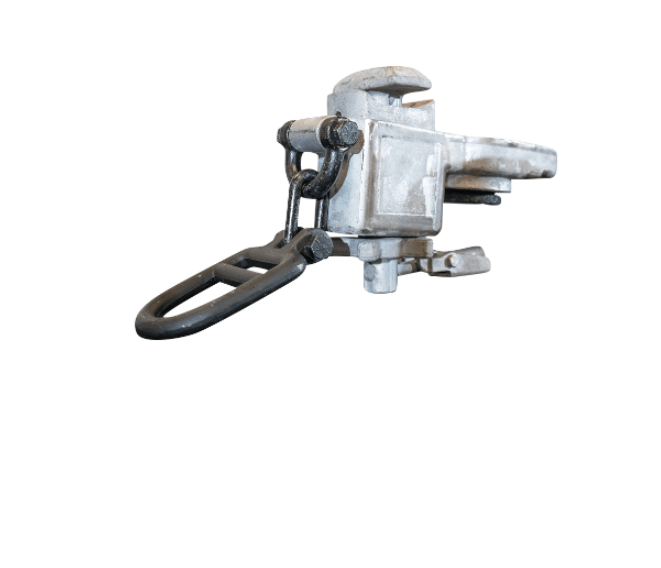
These provisions are typically forged from heat-treated alloy steel, designed to possess both immense tensile strength and slight elasticity. This prevents the metal from shattering under sudden shock loads. Furthermore, a heavy-duty military tie-down ring is rarely static. Advanced designs feature swivel housings that allow the ring to rotate a full 360 degrees horizontally and pivot up to 150 degrees vertically.
This freedom of movement is a critical safety feature. It allows the ring to perfectly align with the angle of the parachute rigging or the securing strap. By swiveling to match the tension load plane, the ring eliminates dangerous side-loading or torque, which are the primary culprits in mechanical failure.
Depending on the application, these provisions take different forms. Flatbed transport trailers often utilize flush-mounted rings that recess completely into the floor when not in use, preventing them from becoming a tripping hazard or obstructing cargo loading. In contrast, heavy-duty tactical vehicles might employ raised, boltable swivel rings that protrude from the chassis, offering rapid access for rigging crews wearing thick protective gloves in austere environments.
The Mandate for Universal Interoperability
Surviving an airdrop is only one part of the logistical equation. Before a tactical vehicle ever sees the inside of a cargo plane, it must navigate a massive, complex global supply chain. The same vehicle must be chained to the deck of a rolling cargo ship in the Pacific, lifted by a dockside crane in Europe, strapped to a flatbed railcar, and finally secured inside the belly of a transport aircraft.
If every vehicle manufacturer used different sizes of lifting rings, or placed them in unpredictable locations, the global supply chain would grind to a complete halt. A crane operator in Germany cannot waste time figuring out how to safely rig a uniquely designed truck from Texas. There must be absolute, universal interoperability across the entire Defense Transportation System.
To achieve this, the military requires all equipment to feature standardized interface points. Whether a soldier is securing a generator, a shipping container, or a heavy transport truck, the hardware must be universally recognizable and mathematically predictable. To ensure this flawless compatibility across all branches and manufacturers, the Department of Defense relies on strict guidelines like MIL-STD-209, which dictates the exact design, positioning, and testing parameters for these vital lifting and tie-down provisions.
The Silent Backbone of Power Projection
We live in an era captivated by stealth fighters, advanced robotics, and laser-guided munitions. Yet, none of these high-tech marvels can impact a battlefield if they cannot be safely transported there.
The humble tie-down ring rarely makes the headlines. It is unglamorous, often coated in matte paint to reduce visibility, and ignored by the public. However, it represents the silent backbone of global power projection. Without these over-engineered, mathematically perfect connection points, armies could not move. The next time you see footage of a massive vehicle drifting gracefully beneath a canopy of parachutes, remember the hidden steel rings holding the entire operation together.